
I first heard about the tunnel legend under Pakūranga College when I was a new Year 9 student. I huddled in the corner of the old library, surrounded by senior students. The air was filled with the smell of old pages and chalk dust. They leaned in and lowered their voices mysteriously, as if even the school walls were listening quietly.
“These tunnels lie right beneath our Rive Building,” one of them said, tapping the ground gently. “Eighty years ago, during the war, when Pakūranga College was still a new school—out of safety concerns, the school built underground air-raid shelters for teachers and students to take cover in emergencies.”
At first, I thought it was just another silly prank played by older students to tease newcomers. Like the old ghost story about the swimming pool, or the vending machine that swallows coins if you press it three times—just classic campus tales passed down year after year. But a few months later, I stayed late after class to finish my design project in one of the art classrooms near the Rive block, and that was when I truly heard the strange sound myself.
It was faint, drifting up from deep inside the wall of the old corridor behind the V1L classroom. It wasn’t the buzzing of classroom lights, nor the distant noise from the basketball courts. It was an empty, distant echo, as if someone was calling my name softly from far underground, reverberating through the brick and stone. Yet the moment I leaned closer to listen, the sound vanished all at once. All that remained was the patter of rain against the window, and the pounding of my own heartbeat.
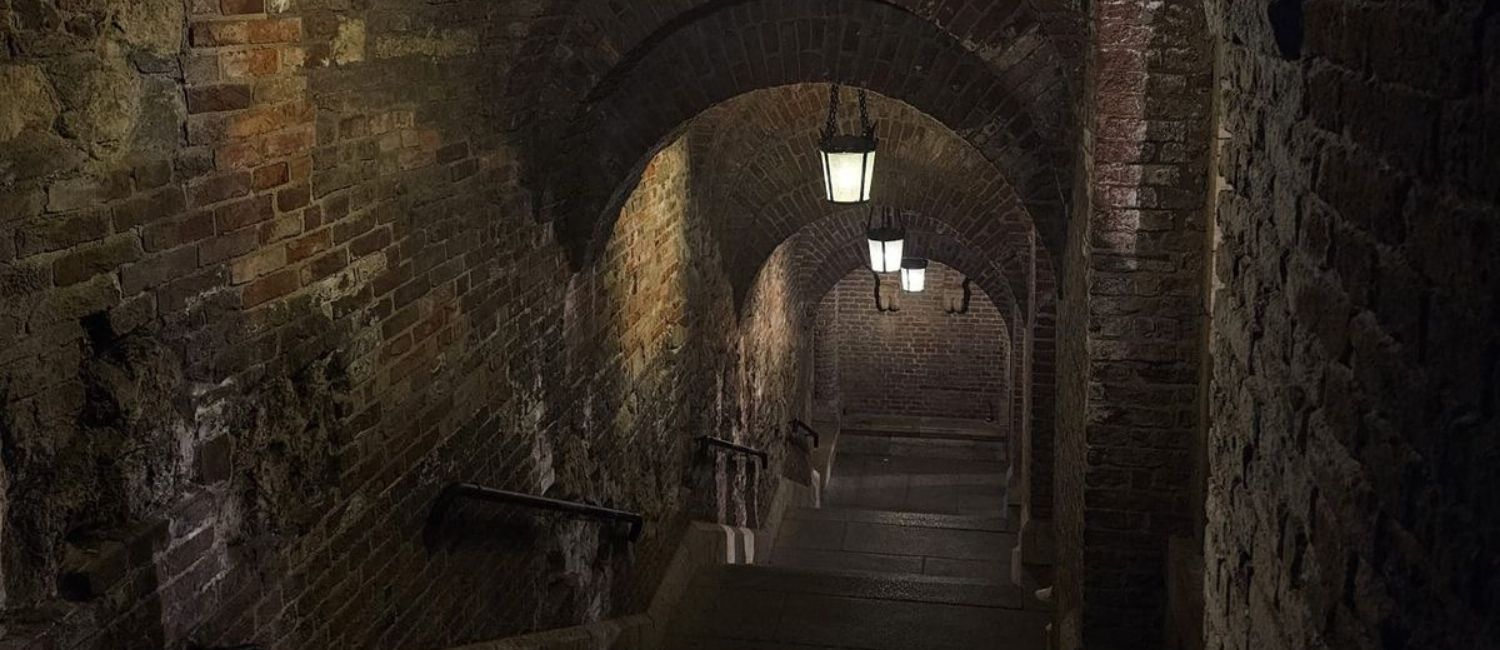
That night, I talked about it with a friend in my year group. She fell silent for a moment, then took out her phone and showed me a blurry old photo. It was a narrow underground passage paved with bricks. The walls were covered in graffiti left by students over decades—initials, casual doodles, and a faded line written in faint letters: Do not go past the third corner. Do not disturb the silence here.
“A few years ago, some senior students went down to explore out of curiosity,” she said slowly. “They got lost inside the tunnel. When they finally found their way out, they said they could hear slow footsteps following them the entire time. But every time they turned around, there was nothing but pure shadows.”
Teachers never take the initiative to talk about this story. Even when students ask curiously, they just smile and dismiss it as campus gossip, claiming the old air-raid tunnels were long buried and sealed off. But if you pay close attention, you’ll notice they always exchange a knowing look whenever the topic comes up; clearly, they know more than they let on.
My tutor teacher has taught at this college for decades and witnessed countless changes on campus. One day, I was staring blankly at the rusted metal door at the back of the Rive block — the one hidden between the V3L and V4L classrooms, half-overgrown with ivy and marked with a chipped “No Entry” sign. My teacher caught me glancing at it and simply shook her head. “Don’t be tempted to explore places like that. They’ve been sealed away for a reason.”
Legends about the tunnels have never truly faded. Some say the tunnels hold more than just bricks and dust; they carry the lingering presence of teachers and students who studied here during the war. Others believe generations of students who snuck down left their thoughts, secrets and feelings hidden in this underground space.
Many people claim that after sunset, they’ve seen tall, shadowy figures wandering the corridors near the Rive building, wearing old school uniforms from decades ago. A group of Year 12 students once stayed back to rehearse for a drama performance and saw a figure standing at the end of the hallway, outlined by the glow of the emergency exit light. They called out, but it walked straight through the wall and disappeared in an instant, as if it had never existed at all.
Last month, I stayed on campus until evening again to return a textbook to the library. The sky had turned completely dark, and the whole school fell into silence, lit only by a few exterior lights, hanging on the classroom walls. As I walked past the Rive block, I stopped instinctively. The walls here felt colder than anywhere else on campus, as if a chill was seeping up from underground.
In that exact moment, I heard that familiar hollow whisper again, faint and distant, like someone calling my name from deep beneath the ground.
I didn’t dare stay any longer. I quickened my pace and sped out of the school gate.
But that faded sentence on the tunnel wall stayed stuck in my mind. I couldn’t help wondering: could those students who walked these halls eighty years ago, and all the pupils who snuck into the tunnels to leave their marks, still be wandering in the dark underground, quietly waiting for someone willing to listen to their stories?
Perhaps all of this is just imagination and legend. Maybe the tunnels only hold soil and old pipes, the echoes are just the wind passing through gaps, and the shadows are merely tricks of light and shadow. But every time I walk past the Rive block alone in the evening, I can truly feel the mystery hidden in the quiet. Faintly yet constantly, the whisper from underground lingers in my ears.
I often wonder: if one day I gather enough courage to explore this underground secret sealed away for eighty years, what untold campus stories would be waiting for me at the end of the darkness?
YukiMew