
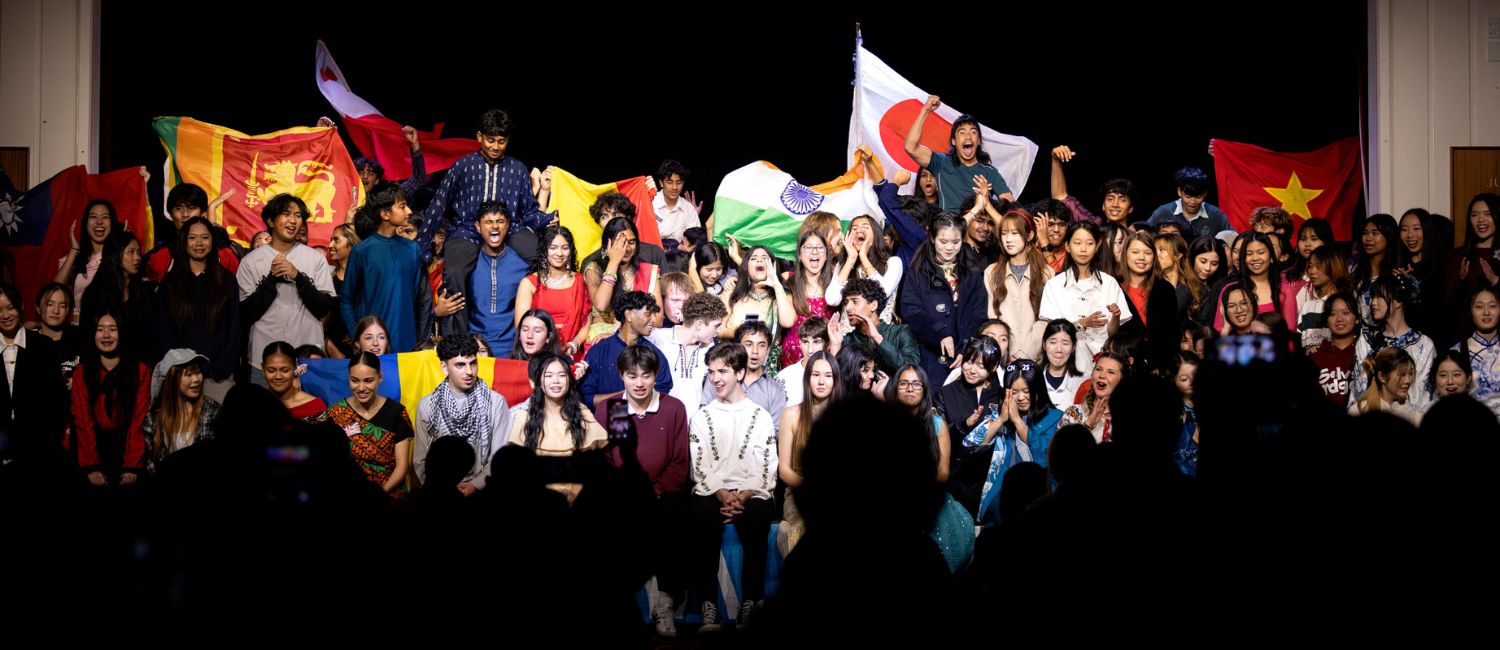
If Pakūranga College were a parent, Cultural Night would be its golden child. Being an event that celebrates customs and heritage, it really is the pride of Pak and brings its community together to feel the mana and whakapapa. It’s something no other school could pull off quite as well as we do. We feel not only with our hands, but all around us, the air just feels warmer and welcoming.
My friend invited me to join a cultural club for the night to get the true experience of a family away from my family. My thanks go out to them for sticking their neck out for me; they also had a grand idea that would fit into my role as a self-proclaimed journalist: interviewing willing participants with a camcorder and microphone. We’ve gained their approval to use our recorded conversations for this article.
Overall, the night itself just felt a little safer and more joyful, like it was chattering away with the moon and stars, watching over us as the air around danced with us.
Back to our journalism, we practically asked the same questions. All along the lines of:
What was your favourite memory or moment when practising your dance?
What are you wearing tonight? Does it represent anything, and when is it worn?
What is the symbolism or meaning of this dance? When or why is it performed?
The first group of the night we interviewed was the Balkans Cultural Group. That night, they were wearing mainly Romanian and Serbian pieces of clothing, traditionally called nošnja. Most of their dance was pretty modernised, with added kicks and flips. They also did one of the most notable dances from the Balkans, called Kolo, which is a South Slavic circle dance.
Next up was the Filipino Cultural Group. They had several performances, including a modern Hip Hop dance, and traditional Valse Vieja and La Jota Moncadena dances. For the traditional dances, the guys wore Barong tagalogs, while the girls wore baro’t saya, both worn for significant events and cultural dances.
The Samoan Cultural Group had a blast that night! When asked what their favourite moment of learning the dance was, the overwhelming response was teaching the dance to the younger performers. This put a smile on my team’s face, as after all, that’s what Cultural Night is about! The main attire consisted of puletasi’s, sei (the flower in a girl’s hair) and ula nifo (a type of necklace). Dances included a combination of a sāsā, ma’ulu’ulu, the boys’ faataupati, a siva vave and more.
The cultural group we were shadowing allowed us to come backstage to really immerse ourselves in the culture. In the final act, everyone rushed onstage. I stayed behind awkwardly because I was not informed I’d be the one up on stage, but they grasped my arm (with consent) and pulled me into the spotlight.
And by spotlight, I mean at the back, where no one could see us, because honestly, neither of us could dance for our lives, and we were just winging it.
I’m sure if you were watching the live stream at home, you could’ve seen us at the back of the stage just standing around — that’s a little Easter egg for you.
After all that, we had a little rest in the group’s classroom for the night. Sharing some food and anecdotes made the night a little more memorable.
The night was dark, but the light flooding the hall and alleyways of Pakūranga College couldn’t be dimmed as culture and customs were woven into the roots that bind us together.
Cossar Salesa-Lee – Year 10